What is a Domain Name?
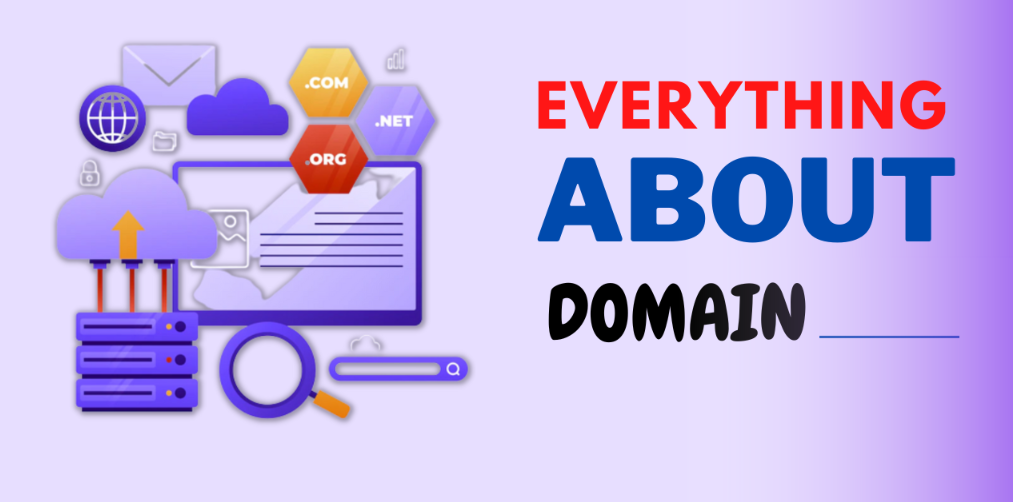
A domain name is the address of your website that people type in the browser to visit your website. In simple terms, if your website is a house, then your domain name will be its address.
The Internet is a huge network of computers connected to each other through a global network. Each computer on this network can communicate with other computers. To identify them, each computer is assigned an IP address. It is a series of numbers that identify a particular computer on the internet. A typical IP address looks like this: 66.249.66.1
Now an IP address like this is quite difficult to remember. Imagine if you had to use such numbers to visit your favorite websites.
Domain names were invented to solve this problem.
Now if you want to visit a website, then you don’t need to enter a long string of numbers. Instead, you can visit it by typing an easy-to-remember domain name in your browser’s address bar. For example, ecommercesathi.com.
How Do Domain Names Actually Work?

To understand how it actually works, we will take a look at what happens when you enter it in your browser.
When you enter a name in your web browser, it first sends a request to a global network of servers that form the Domain Name System (DNS). These servers then look up the name servers associated with the domain and forward the request to those name servers.
For example, if your website is hosted on Babal.host, then its name server information will be like this:
ns1.babal.host
ns2.babal.host
These name servers are computers managed by your hosting company. Your hosting company will forward your request to the computer where your website is stored.
How is a domain name different from a website and web hosting?
A website is a collection of web pages. A website is made up of files like HTML pages, website builder software, images, and more.
If the domain name is the web address of your website, then web hosting is the home where your website lives.
This is the actual computer where your website’s files are stored. Such computers are called servers, and they are offered as a service by hosting companies.
To create your website, you need to have both a domain name and web hosting.
However, it’s important to remember that they are two separate services, and you can buy them from two different companies.
Now you may be wondering, how would it work if you bought them from two separate companies?
You just need to edit your domain name settings and enter the name server information provided by your hosting company. Name server information defines where to send user requests for your domain name.
We recommend getting both your domain name and hosting from the same company. This allows you to easily manage them under the same account.
Types of Domain Names
Domain names are available in many different extensions. The most popular one is .com. There are many other options like .org, .net, .tv, .info, .io, and more. However, we always recommend using the .com extension.
Let’s take a more detailed look at different types of domain names available.
Generic Top-Level Domain – gTLD
Generic top-level domains, or gTLDs, are generic domain extensions that are listed at the highest level in the domain name system. These can be registered by anyone, anywhere in the world.
There are more than hundreds of gTLDs, but the most popular ones are .com, .org, and .net. Other TLDs are less known, and we don’t recommend using them. For example, .info, .agency, and many more.
Country Code Top-Level Domain—ccTLD
Country code top-level domains, or ccTLDs, are country-specific domain names that end with country code extensions, like .np for Nepal, .uk for the United Kingdom, and .in for India. They are used by websites that want to target audiences in a specific country.
Sponsored Top-Level Domain – sTLD
A sponsored top-level domain, or sTLD, is a category of TLDs that has a sponsor representing a specific community served by the domain extension. Sponsored top-level domains are administered by private organizations and industry. For example: .aero, .asia, .travel etc.
Who is responsible for the Domain Name System?
The Internet Corporation for Assigned Names and Numbers (ICANN) manages the domain name system. It is a non-profit organization that creates and implements the policies for domain names.
ICANN gives permission to companies called domain name registrars for selling domain names. These domain registrars are allowed to make changes to the domain name registry on your behalf.
Domain name registrars can sell domain names and manage their records, renewals, and transfers to other registrars.
As a domain name owner, you are responsible for telling the registrar where to send requests. You are also responsible for renewing your domain registration.
How to Choose a Domain Name for Your Website:
There are currently more than 350 million registered domain names, and thousands more get registered each day.
This means that all the good ones are already registered or will be registered very soon. This puts a lot of pressure on new users to come up with a domain idea for their website.
Here are some quick tips to help you choose a domain name for your next website.
- Stick with a .com domain name, as it is the most popular, easy to remember, and easy to promote.
- Make sure it is shorter and easy to remember
- Make it easy to pronounce and spell and eye-catching too
- Do not use numbers or hyphens
- Use domain name generators to come up with clever domain name ideas
How to Buy a Domain Name?
There are many domain provider companies from which we can easily buy domains. We suggest you use Babal.host to buy a domain and hosting too.
How to Get a Free Domain?
To get a free domain, we can go to the site naming register.com.np easily and access the free domain. A free domain will be for a lifetime and can be registered by one person or organization one time.
Frequently Asked Questions:
Over the years we have helped thousands of beginners start their first websites. We have heard almost every possible question about domain names that you can think of.
Following are the answers to some of the most commonly asked questions.
1. What is a subdomain?
A subdomain is basically a child domain under the main domain name. For example, webtraining.shahmamta.com.np is a subdomain of shahmamta.com.np.
Once you register a domain, you have the permission to create subdomains for it by yourself.
2. Can I cancel my registration of a domain name?
Some domain registrars allow you to cancel your domain registration at any time. If you cancel your registration, it will become available for others to register.
Other domain name registrars allow you to simply let your domain registration expire.
In most cases, you will not get any refund for the domain registration. However, some domain registrars do have refund policies, which you may want to discuss with them before canceling your registration.
3. Can I move my website to a different domain name?
Yes, you can. You can point your domain name to your hosting server. You can also keep both domain names pointing to the same website.
However, search engines consider it duplicate content, and that will affect your search rankings.
4. Can I sell a domain name?
Yes, you can sell it. These are like real estate for web. There is a huge demand for good brandable custom domain names.
5. Can I buy more than one domain name?
Yes, you can buy as many as you like.